
23th Day of September, 2026
I. Diedrik of Oakenhold
We emerged from the portal and found ourselves on the outskirts of Veluna City. Unlike waystone travel, there was no vomiting-a blessing for which my stomach offered silent thanks. Veluna City rose before us, a holy town of white spires and cobbled streets where humans comprised the majority, their faces pious and their manners carefully polite. Its main claim to fame, aside from an abundance of pointed hats and disapproving glances, was the large renowned library that dominated the town center-a domed edifice of pale stone.
We caught sight of a religious procession winding through the streets below, complete with a parade of people in pointy hats, incense burners swinging in time to the side-to-side movement of the crowd. The smoke drifted toward us in lazy coils, carrying the scent of myrrh and sanctimony.
“We should head south,” Ender said, his gaze fixed on the mountains rising in the distance. “The Lortmill Mountains. My homeland.”
There was a note in his voice I had rarely heard-something between longing and dread, the particular gravity of a dwarf returning to the bones of his birth.
Shortly after reaching the foothills, we heard the sound of rocks being moved behind a stand of trees. The scraping was methodical, almost meditative.
“More gaming skeletons?” wondered Ender out loud, his hand drifting to his war pick.
The three of us had been creeping for nearly an hour when we heard it.
Clink.
A pause.
Clink-clink.
Not metal. Stone.
The sound came from somewhere ahead, small and deliberate amid the hush of the trees. We slowed, exchanging glances, and slipped between the trunks until the undergrowth opened onto a shallow shelf of broken rock.
There, with his back half-turned to us, sat a dwarf.
He was not hiding.
That was the first unsettling thing.
The second was that he seemed to have known we were there for some time.
He was sorting stones.
Not merely picking them up, either. He handled each one with the solemn concentration of a jeweler examining precious gems. Some he rolled across his broad palm. Others he weighed between thumb and forefinger before dropping them into a battered leather satchel at his hip.
Clink.
One stone met another.
He paused.
Then he calmly turned around.
There was no startlement in his face. No reaching for a weapon. No sudden stiffening of the shoulders. He looked at us with the mild, almost weary curiosity of a man interrupted halfway through an interesting thought.
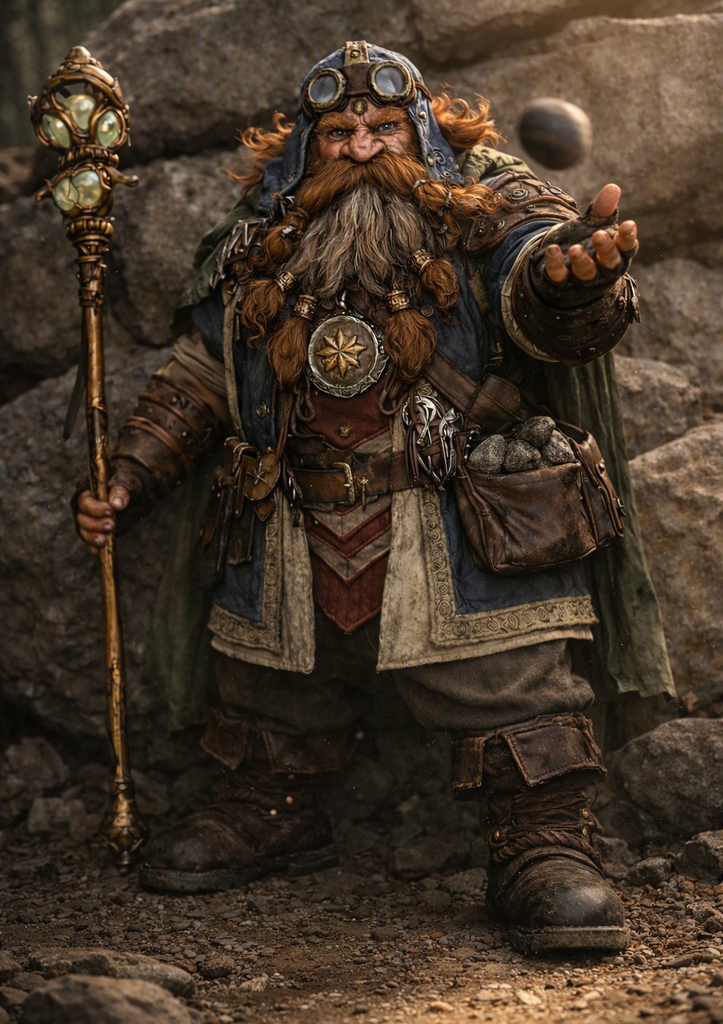
He was a dwarf of the earthen clans, and everything about him seemed to have been made by the same forces that made the mountains.
He was short even by dwarven standards, but immensely broad through the shoulders and chest, with thick arms and a belly that suggested he had never regarded hunger as a virtue. His boots were enormous, battered things, dark with mud and dust, their leather creased and scarred from years of climbing places sensible folk would never attempt. His trousers were heavy wool and hide, tucked into leather wrappings and reinforced with worn plates around the knees and shins.
Over these he wore a long, weather-beaten coat of deep blue-green cloth, its edges embroidered with looping patterns that might have been clanwork—or perhaps the stylized roots of ancient trees. Beneath it hung layers of leather, buckles, straps, pouches, tools, and little charms. His belt was broad enough to serve as a siege engine, and from it dangled everything from knives to coils of cord, small metal implements, carved tokens, and what looked suspiciously like a spoon.
His chest was protected not by conventional armor, but by overlapping leather and hammered metal plates, worn smooth in places by years of use. At the center hung a great circular medallion, tarnished silver surrounding a star-like symbol.
And then there was the beard.
It was magnificent.
Copper-brown near the face and fading into silver and iron-gray toward the ends, it fell in thick, tangled braids almost to his waist. His mustache was equally extravagant, curling outward like the wings of some particularly irritable bird. Small beads, rings, and bits of metal had been worked into the braids—not delicately, but practically, as though anything worth keeping ought to have a place on him.
His hair escaped from beneath a weathered blue hood, where a pair of round brass-lensed goggles rested upon his brow.
They made him look, at first glance, like an eccentric craftsman.
Then you met his eyes.
And the impression changed.
They were sharp.
Very sharp.
The eyes of a man who had spent his life watching mountains crack, rivers change course, fires burn, and people make mistakes. There was intelligence in them, certainly, but also patience—the unnerving patience of stone.
He carried a staff in his left hand, taller than he was, fashioned from dark wood and reinforced with metal. Its head was an elaborate cage of brass and copper surrounding several pale, cloudy stones that seemed to possess their own inner glow. The thing looked less like a wizard’s ceremonial staff than something a miner might have built after becoming fascinated with magic and refusing to stop experimenting.
And he was carrying enough equipment to outfit a small expedition.
A satchel bulged at his side.
Several smaller pouches hung from his belt.
There were stones tucked into the folds of his clothing.
Stones in his pockets.
Stones in a leather pouch.
Stones apparently being held for no reason whatsoever.
Which left us wondering whether he was collecting rocks…
…or whether he knew something about them that we didn’t.
The dwarf studied us for a long moment.
Then his gaze drifted past us, toward the forest behind.
He sniffed.
Once.
Twice.
His bushy eyebrows drew together.
“Three,” he muttered.
We exchanged another glance.
He had counted us without looking.
The dwarf sighed.
“Ye’re quieter than most.”
He looked down at the stone in his palm.
“Not quiet enough.”
There was no threat in his voice. Somehow, that made it worse.
He rolled the stone between his fingers and smiled faintly.
He had the peculiar personality of someone who had long ago stopped being impressed by danger.
Not because he was reckless.
Because he had discovered that panic was usually a waste of energy.
The earthen clans bred their wizards differently from the tower-trained sorcerers of the lowlands. Their magic was not something they considered separate from the world. They listened to stone. They read the grain of cliffs. They knew the language of pressure, fault lines, buried water, metals sleeping beneath mountains. A spell, to one of them, was less an act of command than a negotiation.
And this dwarf had the unmistakable air of a man who had negotiated with mountains and generally gotten the better end of the bargain.
He was calm.
Not gentle, exactly.
There was too much steel beneath the beard for that.
But he was difficult to rattle. He possessed the dry humor of someone accustomed to hardship and the quiet confidence of someone who had survived most of it. He probably laughed rarely, but when he did, it would be sudden and enormous, like a boulder breaking loose from a mountainside.
He also had the look of a chronic tinkerer.
The sort of wizard who would discover a strange mineral, forget to eat for two days, construct three devices to determine what it was, accidentally collapse part of his workshop, and then become tremendously excited about what the collapse had taught him.
His curiosity was almost certainly stronger than his caution.
Almost.
Because beneath the eccentricity, the battered clothes, the ridiculous beard, and the collection of stones was something much harder to miss.
Competence.
He looked like a dwarf who knew exactly what he was doing.
And if he didn’t know?
He looked like the sort who would calmly investigate until he did.
He glanced at the three of us again.
Then he held up the stone in his palm.
“Ye know,” he said, “most folk see a stone and think, stone.”
His eyes narrowed thoughtfully.
“Poor creatures.”
He dropped it into his satchel.
Clink.
Then he smiled.
“Now. Which of ye is going to tell me why ye’ve been following me?”
“Well met,” I offered as an introduction, my hands splayed in a gesture of peace that I hoped looked more diplomatic than cowardly.
“Well met,” he replied, turning calmly toward us, seemingly unfazed by the sudden appearance of three armed strangers emerging from the tree line behind him. His eyes held the sharp, patient intelligence of a scholar who had memorized the world.
I introduced myself as Aelfric the Bard, and he told us that he was Diedrik of Oakhold. He was clearly a wizard-his robes bore the faded sigils of arcane academies-and I suspected a somewhat accomplished magic user, given his nonchalant reaction to our arrival. Most men would have jumped. Diedrik merely looked at us as if we were late for an appointment.
“We are searching for friends of Lazren,” I said. “A wizard.”
“I knew a Lazren… in wizard school,” Diedrik replied, his brow furrowing with the effort of memory. “But I know not of his whereabouts.”
We showed him the medallions and related the story of the tower-our ascent through chromatic puzzles and slumbering wyrms, our meeting with the chained wizard Lazren in that bright, terrible reward room. We sketched out our dealings with the ascendants and our quest to find Phlegan. As the words poured out, I wondered why we were revealing so much of our secrets to a stranger. But somehow, we trusted this dwarven mage. There was an honesty to him, a steadiness that reminded me of Ender, though where the paladin wielded steel, Diedrik wielded intellect.
Before we had finished, Crow’s sharp eyes caught a plume of black smoke rising to the east.
“We should investigate,” the ranger said, already moving.
II. The Scorched Pack
We came to a wide expanse of burnt ground where the earth itself had been charred to glassy black. The air smelled of scorched fur and cooked marrow, a reek that made my eyes water. Crow dropped to one knee, his elven fingers tracing impressions in the ash.
“Wolf tracks,” he murmured. “Large ones. And recently burned.”
We followed the trail, and it did not take long before we found a pack of three fire wolves. They were monstrous things, their fur alight with living flame, their eyes embers glowing with predatory hunger. The heat radiating from them shimmered the air like a summer road.
Diedrik cursed-a remarkably creative string of dwarven invective-as he had prepared a number of fire spells that morning. Next to useless against creatures born of flame. He adapted with the pragmatism of a veteran spellcaster, extending his hand and hitting the nearest beast with chill touch instead. Necrotic frost spread across its flank, the flesh and hair blackening and necrotizing even as Crow’s arrows pierced its ribs and Ender’s trusty war pick finished the job with a crunch of bone.
We made short work of the second wolf. Diedrik impressed us with his range of attack options, his hands weaving a complex pattern before a beam of crackling blue energy lanced out toward the creature. The lightning formed a sustained arc that danced across the wolf’s flaming hide, stunning it into rigid paralysis. Crow and I finished it off with arrows-his shaft taking it in the throat, mine in the chest, a duet of death that dropped the beast into the ash.
Just then, a rumbling echoed from farther up the mountain. The ground trembled beneath our feet, dislodging pebbles that clattered down the slope.
“Fire Giant!” Crow yelled, his voice cracking with a rare note of panic. He turned and started running with the heedless speed of a man who had seen what fire giants could do and had no desire to become a cautionary tale.
The three of us turned as one and followed the ranger down the mountain, heading east, our lungs burning and our boots skidding on scree. Behind us, the air grew furnace-hot, and the shadow of something vast and burning loomed against the clouds.
III. The Road to Veluna
After catching our breath in a hollow where the wind carried the scent of pine instead of cinders, we decided to head to Veluna City to buy weapons, armor, and provisions. Our supplies had dwindled, and my purse felt lighter than a bard’s promise.
We were on the road, dust rising around our boots in the afternoon sun, when we saw a group of five armed men approaching from the opposite direction. They moved with the loose swagger of hired muscle, their armor mismatched, their swords well-used.
We stopped. They stopped. We stood facing them forty feet apart, and the silence that followed felt heavy as a held breath. The air tasted of tension and road dust.
Then one of them pointed at Crow and me, and referred his comrades to a parchment he had unrolled. His lips moved as he read, his eyes flicking between the page and our faces.
“It’s them, alright,” said one, his voice carrying the satisfied tone of a man who had found a coin in the gutter.
Another fighter emerged from the bushes at the side of the road, his sword already drawn. I counted quickly. Six? Seven? How many were lurking in the foliage?
“By order of Lord Nerof Gasgal,” the leader announced, his chest puffing with borrowed authority, “you two shall accompany us at his Lordship’s convenience.”
Diedrik replied on our behalf. With a fireball.
It exploded in the center of the group with a roar like a dragon’s belch, scattering the men like ninepins. Some were thrown clear, others caught fire, their cloaks blazing as they rolled in the dirt. The smell of singed leather and burning hair filled the road.
The fire damage sent them into a frenzy. These were no mere mercenaries-they were berserker bounty hunters, their eyes glazing with battle-rage as they charged through the flames toward us. We held them off with a combination of spells and skillful bow work, Diedrik’s magic crackling alongside Crow’s arrows. But it was Ender’s crushing divine smites that turned the battle decisively in our favor. Radiant light burst from his war pick with each strike, and the barbarians, so fierce moments before, reverted to regular fighting men, wildly swinging their swords without coordination, their rage guttering like candles in a storm.
It was at that point, just as I was starting to enjoy myself-my mockery sharp, my footing sure, the music of battle singing in my veins-that Crow offered them their lives in exchange for their total surrender.
“Agreed!” shouted their leader, dropping his sword immediately. He shuffled backward warily, his hands raised, before fleeing into the trees with those of his men still able to run. They disappeared into the undergrowth with the alacrity of men who had learned that some bounties were not worth the collecting.
Crow bent and swiped the list from a dying bounty hunter who had collapsed at the roadside. The elf’s eyes scanned the parchment, his expression darkening.
“We’re wanted for jailbreak,” he announced. “Seventy-five gold pieces each for our capture.”
He continued reading, and his eyebrows rose. “Vyzolta, meanwhile, is valued at a castle with huge tracts of land.”
The parchment included a list of all the ascendants and their second-in-commands-a comprehensive catalog of our enemies, neatly alphabetized, as if Lord Gasgal were running a particularly lethal dinner party.
A Relay
War Mage Jespa
BK Xatalan
Org Nenshen
Karen
Asashna
Delto Kue
I looked at Ender, then at Crow, then at Diedrik, who was brushing road dust from his robes with the calm demeanor of a man who had just committed arson and found it spiritually refreshing.
“We’re going to need better lawyers,” I said.
And with that cheerful thought, we continued toward Veluna City, our names worth more than I had ever imagined, and our troubles only just beginning.