
I. The Last Mindthorns
Phostwood’s damp twilight hung close as Crow, determined to recover his lost lightning dagger, rooted through a clutch of wormwood shrubs at the swamp’s edge. I kept an eye on his fumbled search until, with a flash of halfling brilliance, I spotted the familiar hilt tangled in moss. “Finders keepers!” I crowed, tossing it to Crow with an air of triumph. His scowl was as dark as the bog. After a moment, he tossed the blade back to me. “You take it—short blades suit your short arse.”
We pressed deeper, the air saturated with humidity and rot. The Phostwood was a world of its own: oppressive, wet, and alien, where the trees pressed so close they seemed to be conspiring, and the clinging fog muffled sound and sense alike. Now and then, a chorus of distant croaks or the drone of monstrous insects would rise, making it hard to tell if we were surrounded by hundreds of creatures or just one, very hungry, very patient one tracking us in the gloom.
As we hunted for the remaining mindthorns, our path led us around pools of black water and through curtains of moss that dripped with some nameless ooze. Crow’s elven eyes picked out the next likely tree—and that’s when we found it: a corpse half-consumed by the swamp. What once had been a traveler was now a horror—skin sloughed away from limbs, gray meat visible beneath. The face had caved in, eyes long gone, jaw half-dissolved, moss growing from the sockets and mouth as if the forest were eating, not just claiming, the body. The hands, still clutching at the roots, were webbed with decay, fingers bloated and black. The stink was nearly alive, a tangible thing that twisted in the nose and pressed down on the chest. The swamp here was not just caretaker but predator.
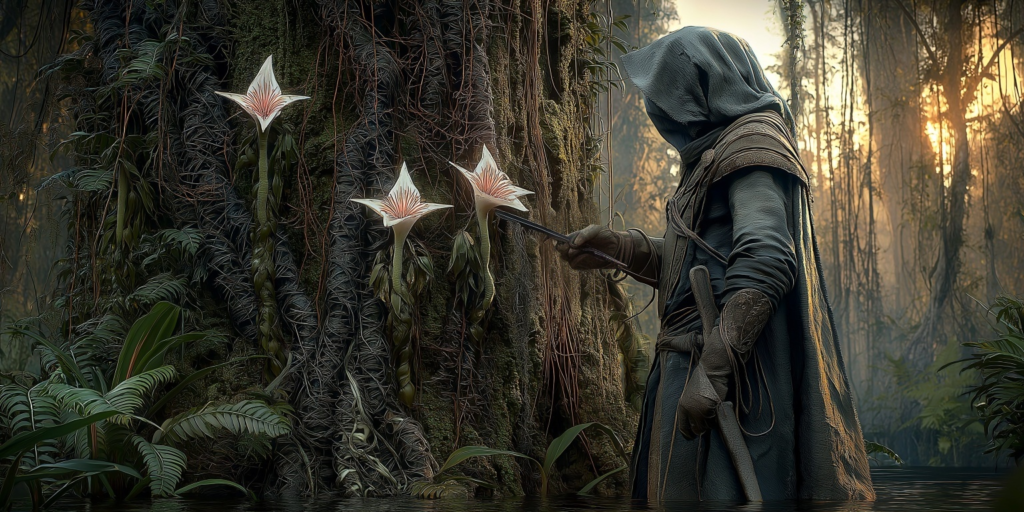
Crow, ever focused, pointed us to the next two trees—each held three mindthorns, but his luck with the extraction tool was as rotten as the corpse. Most snapped off, their precious sap leaking out and sinking into the muck, but we managed to salvage two more. Our boots squelched onward, the forest growing thicker, the light bleaching out to a sickly gray-green, the only landmarks the monstrous trees and the ever-present, suffocating mist.
Before we could search another tree, I paused to offer Crow a few words of healing, and Ender, with that clumsy but well-meaning grace of his, laid his thick hand on my shoulder. I swear, his “healing touch” feels more like being walloped by a kind-hearted boulder, but it works.
II. Bridge over Troubled Waters
We returned to our familiar marching order: Crow a ghost in the gloom ahead, Ender and I plodding behind, wary of every sucking pool. Soon enough, Crow signaled—a rotting wooden bridge loomed ahead, slick with moss and sagging under its own weight.
As Ender waded forward, his boot sank deep into a watery hole, and his maul clanged against his plate armor—the sound ringing out like a dinner bell for anything with teeth. Sure enough, two croakers scrambled out from the bridge, eyes wild and spears ready.
Battle was joined. Ender, never the cleverest, but always enthusiastic, called down a sacred flame on the leftmost croaker. The croaker screeched, but the damage was mostly to its pride. I invoked true strike and lined up my crossbow, striking the same target and sending it cartwheeling backwards into the muck. Crow, in a rare display of clumsiness, tried to close in and slipped—face-first into the mud, right over a rod jutting up from the swamp. The ranger, usually so dignified, emerged with pondweed trailing from his hair.
The croakers, robbed of the element of surprise, fell quickly. Ender’s maul rose and fell with the brutal rhythm of a blacksmith. For once, the boggy ground was more dangerous than the frogmen.
After the carnage, we examined the rod Crow had tripped on. It was caked in grime but had a small, red button at one end. Ender, examining it with a furrowed brow, declared, “This is a gravity-defying, immovable rod—can hold up a dragon, or so I’ve heard.” He slung it over his shoulder with pride, eyes glittering as if he’d just found a lost relic of Moradin himself. I couldn’t help but imagine the chaos he’d unleash with it.
III. Walls and Whispers in the Swamp
Ahead, one last mindthorn, visible in the gloom. But so too was something far more unnatural: a low, crumbling stone wall—utterly out of place in the heart of the swamp. Crow beckoned us forward and pointed to a crack in the masonry, from which a pulsing, ominous orange glow seeped. As Ender pressed close, his face twisted, the paladin’s senses registering a wave of evil so foul it nearly staggered him—his features twisted as if he’d tasted rot.
We wanted no part of that. Crow, perhaps inspired by horror, managed to extract two of the three remaining mindthorns with efficiency at last. Having filled our quota, we turned and hurried for the sanctuary of the standing stones, not daring to look back at the wall or its haunted light.
It took nearly the entire day to wrestle our way out: hacking at vines, wading through muck that clung like hands, lungs aching for fresher air. When at last we emerged, blinking into the open, the horses greeted us with irritable snorts, having nibbled every blade of grass within reach. We moved them to new pasture, breathing relief in open air.
IV. The Road to Riftcrag
The next morning, the world seemed less hostile: the mindthorn quest complete, heroes (relatively) intact, and the promise of a hot meal ahead. We set off for Riftcrag, the landscape slowly shifting from marsh to rugged high ground. As dusk fell, we made camp by a rocky outcrop, each of us casting glances toward the horizon and the silent, menacing city beyond.
Crow took the final watch, and just before dawn, guided us quietly around a boulder to where a bedraggled human stumbled along the path, dragging a bulging burlap sack. His face was ashen; wide, red-rimmed eyes stared blankly at the ground. He flinched at my approach, terror and shock etched into his features—a man hollowed out by what he had escaped.
His story was halting, broken by fits of trembling. “I—I came from Riftcrag. Escaped last night. Guards everywhere, but… it’s chaos inside. Blood, bodies—no one trusts anyone.” Tears streaked down his face. He clutched his sack—full of food, a change of clothes, a small marble idol, a portrait of a smiling woman. He looked like a man who’d run from hell and wasn’t sure he’d left it behind. We gave him comfort, a little food, but knew he would only slow us. We watched him disappear, still muttering about “blue eyes” and “the club,” and shouldered our own dread.
V. Siege and Slaughter
From the woodland’s fringe, Riftcrag looked like a vision from a fever dream: bodies piled outside the gates—men, women, children, guards. Some were hacked to pieces, limbs cast aside like butcher’s scraps. Others bore the unmistakable stamp of blunt force: heads crushed, faces caved in, torsos shattered as if a giant had swung a tree trunk through them. Black smoke curled from the heart of the city, the air thick with the stink of burning meat and blood.
Crow, moving like a ghost, skirted the perimeter to examine the dead. When he returned, his voice was cold. “It’s not just the guards. It’s everyone. Some were tortured—cuts, burns, wounds reopened over and over. Some… just beaten until there was nothing left to break.”
We hid the horses deeper in the woods, debating our options. Ender, for all his strength, was not one for complicated plans. “We could just go through the front,” he grunted. Crow rolled his eyes. “And get our skulls caved in by a club the size of a wagon.” We decided on stealth: circling to the north wall, watching for gaps.
It took careful scouting, but we found a breach—a ragged hole barely guarded by two sentries in the city’s blue-and-red livery. We crept through the trees, Ender and Crow flanking from the sides, myself lurking behind a fallen trunk. At a signal, I stepped into the open, hat of disguise transforming me into a wide-eyed, filthy 10-year-old girl.
“You two want a match?” I called, grinning with all the insolence of a schoolyard bully. “Your face… my arse!”
The guards stared, uncertain. At that moment, Crow fired an ensnaring strike—vines burst from the earth, wrapping one guard’s legs, thorns biting deep. Ender, armor clanking, leapt from the shadows with a roar and swung his maul at the other, catching him across the jaw and sending him spinning.
The first guard, still trapped, struggled as Ender bore down, hammering him with a divine smite, radiant light searing through his body. Crow dispatched the sword-bearer with two quick, silent strikes. In the end, both guards were brought to their knees—one groaning, the other barely conscious.
Ender, looming, grabbed the axe man by his collar. “Who did this? Who’s in charge?” The guard, blood bubbling from his lips, gasped, “I—I don’t know. They appeared—out of nowhere. Blue—blue eyes—passed the check… armor… told me to guard…”
“Blue what?” we all pressed.
“Blue… eyes…” he choked, “like—like the girl, the one with the silver hair… her eyes went blue, and… she—she stopped moving. It’s all… wrong…” His head slumped forward.
We exchanged glances. Brimaz. The same blue-eyed compulsion the Relays had shown. The same blue as Phlegan’s eyes before she slipped into her trance. We stripped the uniforms, Crow and Ender donning the bloody tunics, and left the bodies in the weeds. I, with a flourish, transformed into a nervous child, and let them each grab one of my arms like overzealous guardians.
VI. Into the Inferno
We climbed through the breach and into a waking nightmare.
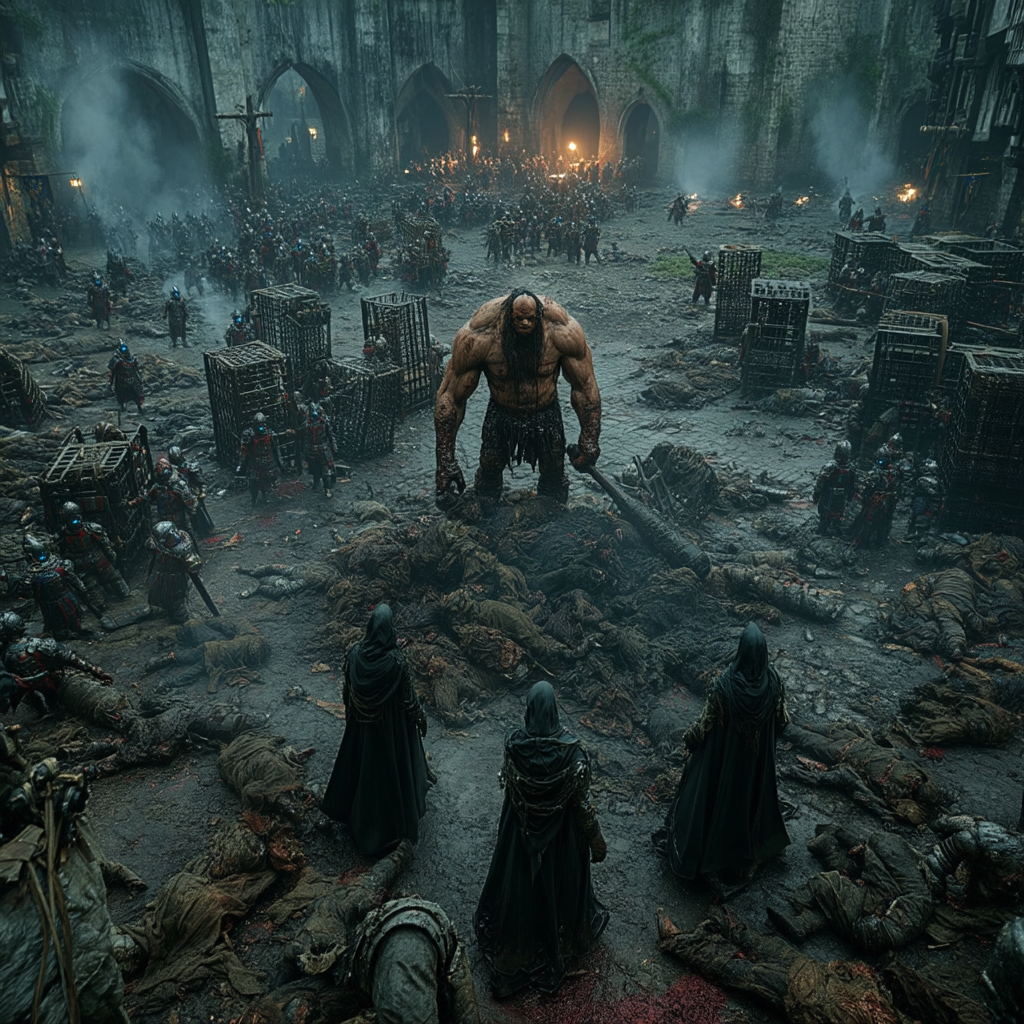
The city square was a vision of carnage and dread. Corpses lay everywhere—limbs twisted, entrails steaming in the cold air, pools of blood congealing around piles of dead. Smoke twisted through the ruins, the air thick with screams, the stench of burning flesh. Patrols of blue-and-red guards hustled terrified townsfolk from one horror to the next: some thrown in cages, others lined up in the mud, a few handed over to the most appalling figure of all—the hill giant in the center of the square.
He was a mountain of a creature: sixteen feet of muscle, blood and filth caked on his hands and belly. He swayed, club in hand, eyes vacant and wild. As we watched, a prisoner—a woman, broken and sobbing—was shoved before him. Without hesitation, the giant raised his club and brought it down with a wet, splintering sound. Her body was reduced to a red smear, tossed aside by a single swing. Lifeless, it was dragged to a growing pile of corpses behind a cage.
Three Relays stood around the giant, arranged in a triangle, their faces shadowed but their blue eyes glowing with unnatural intensity. Dark communication crackled between them—were they controlling the behemoth? Or merely reveling in the chaos? The sight of them froze the blood in my veins.
We wove through the square, trying to pass as captors and captive, but every guard, every Relay, every passing glare felt like it could see through our disguises. Sweat trickled down my back; the patrols moved like ants, sometimes so close we could smell the fear and blood on their skin. A single wrong word, a single glance, and we’d join the piles of dead.
The guards themselves, for all their brutality, were gripped by terror. Their eyes darted from the Relays to the giant to their prisoners and back again. Beneath the shouts and violence, a desperate fear simmered—a sense that they, too, were living on borrowed time.
Captives were sorted ruthlessly: some dragged to cages, others simply kicked to the side, a few unlucky souls forced toward the waiting giant.
VII. A Friend in the Fire
Crow and I broke from the press of bodies, ducking down a narrow alley toward Triss’s apothecary. We scaled the fence—Crow nimble as a gecko, me with a helpful boost. Ender’s approach was less elegant: clanking, grunting, armor scraping wood as he heaved himself up, the immovable rod—so recently his prize—falling out with a heavy clunk as he tumbled over the top. “Honestly, Ender,” I quipped, “you inherit a ready-made step and still manage to make an entrance that could wake the dead.”
Inside, the house was choked with soot and silence. We crept through blackened corridors, hearts pounding—each step bracing for a corpse or an ambush. Instead, a slender elven woman appeared from a shadowed doorway. “Finally,” she whispered. “Come quickly. I am Treaña, friend of Triss. You can trust me.” Oddly enough, we did.
Relief flooded through Ender as Treaña reassured him: “Your sister is safe. She and Triss escaped the city—Phlegan is with the Fér-nem now.” I felt my knees weaken; the tension of the last days finally loosened its grip.
We handed over the sack of mindthorns, Crow counting out the extras for Mora near the south gate. Ender, with a flourish that only a dwarf could muster, swung his heavy sack onto the table—its mouth spilling open to reveal the basilisk head, its lidless eyes staring. “Basilisk eyes,” he declared, as if he’d slain the beast with his bare hands.
Treaña gasped, then nodded somberly. “You’ve broken the compulsion spell. If this remedy works, the balance of power will shift, and those who weren’t already hunting you… will be now.” I had a hundred questions, but Treaña rushed us out the back door, whispering, “Go—hide yourselves. The world is watching.” The last thing I saw was her determined face framed by the soot-stained door before it slammed shut.
VIII. Crossroads
We scrambled back over the fence. Crow and I landed silently; Ender’s ascent was a cacophony. The immovable rod tumbled loose again, and I couldn’t resist: “A paladin who owns a perfect climbing aid, but chooses brute force instead. Moradin must be rolling in his forge.” Even Ender managed a wry grin as he stuffed the rod back into his oversized borrowed tunic.
We slipped through alleys, hugging walls, dodging patrols by seconds. Every step was a test—the memory of the hill giant’s club, the stink of burned flesh, the blue-eyed Relays burned into our minds.
Once outside the city, we crept back to the woods, untethered our hungry, anxious horses, and made camp in the shadows of the trees. We exchanged glances, the question hanging in the air.
“What now?” I asked.
“South,” Crow replied. “To Trigol. To find Chun the Unavoidable. If there’s a chance to understand what’s happening to Phlegan—and what Brimaz wants—we’ll find it there.”
Ender nodded, his massive hand resting briefly on my shoulder, then Crow’s. “We do this together,” he said. “No matter what.”
And with blood behind us and blue eyes ahead, we turned south, into whatever fate waited on the road.