
I. Between the Abyss and the Gloom
The trail to Riftcrag wound like a nervous thought, threading a perilous path between two equally dreadful fates: to the south, the yawning abyss of Riftcrag Canyon; to the north, the suffocating gloom of the Tangles Forest. The road itself was a reluctant truce, pressed narrow by nature’s competing threats. On the forest side, thick vines and gnarled roots crept across the trail like greedy fingers, as if the woods yearned to reclaim every stone and hoofprint. The air was heavy with the scent of rot and leaf-mould, each shadow flickering with the threat of movement—shapes lingering just out of sight. I learned quickly, for the sake of my sanity, to keep my gaze fixed forward.
And yet, despite the certainty of instant death that the canyon promised, all of us—yes, even steadfast Ender, who is as immovable as he is stubborn—favored the edge of the drop over the embrace of the trees. Crow, usually the forest’s own child, kept to the cliff with an uncharacteristic wariness, his amber eyes coolly calculating every step. As for myself, I trusted the canyon’s honesty. A fall is a fall. What waits in the forest is altogether less forthright.
II. Dusk and the Hidden Threat
We made good progress that first day, our carriage lurching along a trail that seemed to shrink with every mile. Twilight bled into the sky, casting long, grasping shadows. Crow, ever the scout, slipped silently ahead and returned with urgency etched across his features. With only a look, he drew us to a patch of ground that seemed subtly wrong. He probed it with his shortsword, and the earth sighed and gave way—a pit trap, ten feet deep, its spikes still slick with blood.
Ender, never one for half measures, kicked the false ground away, revealing the grisly end below. We wrestled the cart around the pit, every creak of the wheels sounding like a prelude to disaster. But as true darkness settled, the risk grew too great. The prospect of a slipping wheel and a plummet into the canyon’s hungry void was enough to halt even our bravest hearts.
We made camp, circling the wagon and lighting a fire to hold back the dark. My first watch passed in anxious silence. Ender’s shift was a wall of stoic calm, his silhouette framed in orange glow. And then came Crow, as silent and alert as a held breath.
III. Nightfall: The Specters’ Wail
I woke to sudden violence—Crow shaking me awake, eyes lit with alarm. The air pressed down, thick and suffocating. And then, through the wavering firelight, we saw what haunted our dreams: specters. Four—perhaps more—gliding at the edge of vision, their forms flickering between mist and shadow, circling from the direction of the Tangles.
Their wail was a sound to pierce the soul. Then, with dreadful certainty, they attacked.
Crow’s bow sang, loosing an arrow at the specter that dared fondle our frying pan (a domestic offense I shall not soon forgive). The arrow passed through its spectral chest, and the creature shuddered, shrieking in outrage. Sensing opportunity, I drew on the Feywild’s whimsy and cast Faerie Fire, dousing three spirits in shimmering radiance and painting them as prey.
Ender strode forward, his faith blazing as he called down radiant energy, weakening the marked specters with holy conviction. Yet, our blood ran cold as the fourth spirit pulsed red, its energy snaking toward Phlegan’s motionless form. It chanted, low and terrible.
Before fear could freeze us, Crow’s lightning dagger whistled through the night—crackling, blue, and true—breaking the spell and saving Phlegan from whatever dark magic crept her way.
With a roar, Ender unleashed his wrath, weapon swinging in a flurry of blows until the specter collapsed, dissolving into the night. Crow, ever resourceful, battered another specter with the frying pan; its form flickered, its cries growing weak and pitiful. Ender’s blows landed, but the lack of solid flesh left him visibly frustrated. These foes refused the dignity of a good, honest crunch.
Meanwhile, a specter’s touch found me. Life drained away, cold and absolute—nothing like winter’s chill, but the cold of endings. Through the haze, I saw Ender charge, crashing through the fire and calling down Sacred Flame; the specter unraveled, whimpering in the light.
Crow, relentless, pressed the attack. After a flurry of misses, lightning arced from dagger to ghost, and the last spirit crumpled into oblivion.
The two remaining specters shrieked, an ear-splitting sound that echoed from stone to forest, but as dawn’s first rays crested the canyon, they burned away—banished by the sun.
IV. Shadows, Rings, and Watchers
We traveled on in silence, the world feeling narrower between the abyss and the woods. By midday, Crow revealed another pit trap—this one already occupied. A body, skewered and forgotten.
Naturally, I volunteered to investigate. Lowered between the spikes, I searched the unfortunate soul—a human male—and recovered ten gold. As I was hauled up, a glint caught my eye. “Lower me again!” On his finger: a silver ring, set with a stone swirling blue and silver, mesmerizing and almost alive. We passed it between us, entranced, until a crashing in the forest snapped us back to reality.
We readied ourselves as the brush parted, and out came an eyeball the size of a sheep’s head—then another, then two more. The monstrous floating sphere revealed itself, crowned with writhing eyestalks and a gaping maw. Its great eye fixed on us, narrowed, and—impossibly—it winked. Was there a hint of a smile? Before any of us could speak, the spectator drifted back into the gloom. Ender, for once, found just the right words: “What the fuck.” Crow and I, in unison: “Vyzolta.”
The ring pulsed, warm and alive, then abruptly went cold. I pocketed it. Some mysteries, I think, have their own timing.
V. Riftcrag: City on the Edge
By twilight, we arrived at the looming West Gate of Riftcrag, where the city’s stone ramparts rise forbiddingly above the plain, crowned with pikes streaked in old, dried blood—a clear reminder to visitors that Riftcrag is not a place for the faint of heart. Thankfully, the pikes were mercifully free of heads. For now.
The guards looked us over with suspicion, their armor nicked and tarnished by the dust of canyon winds, but Ender stepped forward, affecting the gruff demeanor of a working miner. To my astonishment, this seemed to be the secret password—either that or dwarves with mauls are simply too much trouble to turn away. The gates creaked open, and we were swept inside by a tide of noise, light, and the sharp tang of city life.
Riftcrag is not a city so much as an argument made manifest—a place where stone buildings jostle for space atop one another, narrow alleys and market lanes twisting in defiance of logic. The architecture is utilitarian, with thick walls, iron-reinforced beams, and balconies from which laundry, flowerpots, and the occasional boot are flung with equal abandon.
The streets throng with miners, traders, and laborers of every stripe—humans, dwarves, halflings, the odd tiefling or half-orc, all shouting to be heard above the rumble of carts and the clanging of distant forges. Merchants hawk their wares from canvas stalls, their voices competing with the cries of porters and the relentless slap of boots on cobble. Every other corner seems to sprout a tavern, a pawnbroker, or a vendor of questionable stew.
The air is a layered cake of smells: the acrid tang of coal smoke, the earthy reek of sweat and ore, the faint breath of river trade rising from the Artonsamay far below, and—when the wind is truly unkind—a lingering hint of tanneries and rendered fat.
Yet for all its chaos, Riftcrag feels safe in the way only a city that expects trouble can. Watchful guards patrol in pairs, and the architecture—practical, ugly, but enduring—speaks to a place built to weather storms, raids, and, presumably, the odd magical apocalypse.
Even Ender’s perpetual scowl seemed to ease as we wove through the market. Crow, for his part, drifted at the edge of the crowd, eyes sharp for any plant or peddler of rare herbs. I, Aelfric, felt the familiar thrill of civilization, where information and gold flow with equal speed and the only thing more numerous than secrets is the number of ways to get yourself killed for asking the wrong question.
VI. Triss and Mora: The Wise and the Wild
We were directed to Triss, healer of some renown, whose home nestled quietly in the lower city amidst a riot of overgrown vines and a well-tended herb garden. A crescent moon sigil adorned her door, and the faint glow of lantern light spilled onto the stoop. Inside, Triss herself greeted us—a woman in her fifties, dark-skinned and graceful, her eyes sharp and her smile tinged with a knowing amusement. Her blue and white robes were simple, but carried an air of quiet authority, and she moved with the calm assurance of one who has seen every manner of wound, woe, and idiocy that Riftcrag can muster.
She did not blink when we explained Phlegan’s plight—indeed, she looked at us as if unconscious adventurers were as common in her parlor as stray cats. With a practiced nod, she had us carry Phlegan into a back room suffused with the scent of burning sage, rosemary, and something sharper—perhaps vervain or the memory of old pain.
Raising a single, skeptical eyebrow at my stumbling tale of “a slip near the canyon and a bump on the head,” Triss regarded me as one might regard a child caught with hands sticky from the honey pot. Ender’s eyes rolled so far back I feared he’d strain something, while Crow found a sudden fascination with his boots.
With a wry smile, Triss dismissed my narrative and got to work. Closing her eyes, she gathered a ball of pulsing, opalescent energy between her palms—magic as elegant as it was unnerving. Threads of this light drifted into Phlegan’s nose and mouth before drawing back, carrying what I can only assume were secrets and symptoms meant for Triss alone. She watched the swirling threads, lips moving in silent conversation with the mysteries of the soul, then snapped open her eyes.
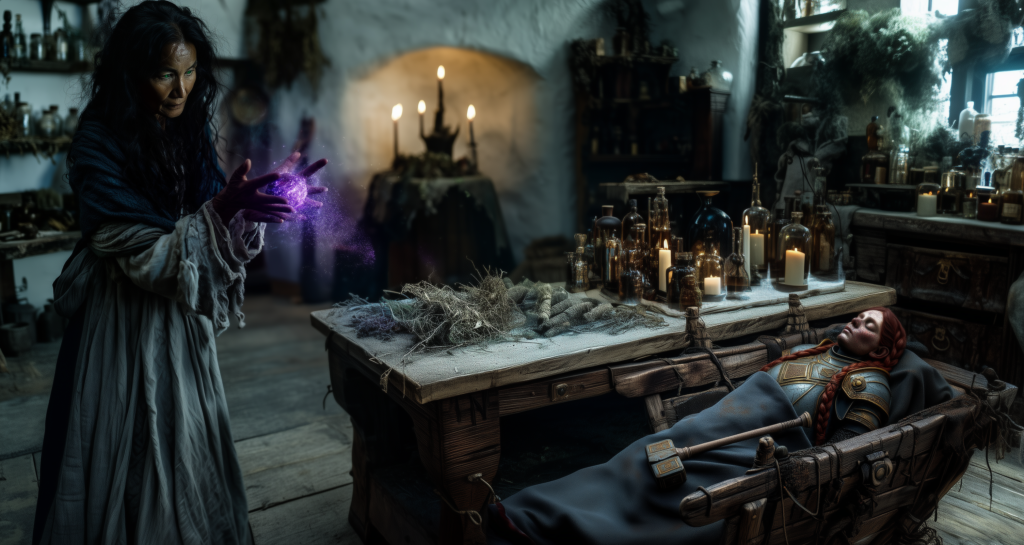
“She’s under a compulsion spell. Powerful. And, I suspect, recently broken.” Her gaze flicked from Ender to Crow, then finally settled on me with the look of a woman who knows full well she’s being lied to. I gave my best innocent bard’s grin and said nothing.
Her terms for a cure were brisk, businesslike, and utterly nonnegotiable:
A basilisk eye (“One lives in a den nearby—between here and Stoink. You’ll know it by the petrified goats, the warning signs, and, should you be especially unlucky, your own transformation into garden statuary.”)
Three mindthorns (“Five would be better. Ask for Mora at the southern gate. Tell her I sent you, or risk becoming a new addition to her decor.”)
Seventy-five gold (“And that’s the friends-and-family discount,” she added, as Crow’s face turned the color of curdled cream.)
We left Phlegan in Triss’s care, promising a swift return—though not, I hoped, as further patients.
Our next errand took us to the outskirts, where Mora’s hut squatted alone like a toad among toadstools, set conspicuously apart from its neighbors. The building was an exercise in poor taste and worse hygiene: walls of lumpy mud, adorned with a veritable bestiary of skulls and bones—dire wolves, deer, an aurochs, and, as Crow noted with growing delight, even a barghest, the jawbones of which he explained in detail to a rapt Ender and a queasy me.
Crow’s fascination was matched only by Mora’s apparent delight in unsettling her visitors. The door flew open to reveal a woman whose hair resembled a bird’s nest after a storm, her eyes twinkling with mischief and suspicion in equal measure. She peered at us, vanished, then reappeared when Ender—always one for blunt honesty—shouted, “Triss sent us!”
That was the magic phrase. Mora let us in, but not before sizing each of us up as if picturing the best way to boil us down for potions. Her hut was a clutter of herbs, animal pelts, and odds and ends that made my archivist’s soul weep. She performed her eccentricity with theatrical relish, each cackle and glare a calculated move in some private drama. I rather admired it, if I’m honest.
Mora’s terms? “Bring me three mindthorns. They grow in the Phostwood, where the Artonsamay and Yol rivers meet. The swamps, mind you—look for the vines that wrap the trees, but watch for the croakers. Nasty folk. Slimy. Like most city politicians, but with better table manners.”
She handed Crow a wicked-looking extraction tool (“Don’t stab yourself. I’m running low on mindthorns, not rangers.”), then ushered us back out into the daylight with a theatrical shoo. I suspect the skulls on her hut were as much for show as for warning, but I made a mental note to keep my bones firmly inside my skin.
Ender, never one to balk at a challenge, muttered about petrification being just another excuse to skip breakfast. Crow, meanwhile, was already planning our route to the Phostwood, regaling us with facts about swamp flora, poisonous frogs, and the best way to avoid getting eaten by things that “move like water and bite like hunger.” I, for my part, resolved to stay behind Ender’s shield and Crow’s boots.
We ended our day at the Drunken Miner Inn, where the clamor of patrons, the comforting stink of spilled ale, and tales from the barkeep provided welcome relief. We learned that a basilisk’s presence has made the canyon’s trails less safe—a situation, we were assured, that would be handsomely rewarded should we rid Riftcrag of its stony-eyed menace. Ender perked up at the prospect of free food for life. Crow took notes on local rumors. I ordered a second round and toasted to the hope of a night’s sleep untroubled by dreams of vines, croaking fiends, or inexplicable wit.
Sleep, when it came, was thin and haunted. I dreamed—again—of creeping roots, spectral eyes, and Mora cackling as she weighed my skull for shelf space. Morning came too soon. The city outside buzzed with purpose, and we readied ourselves for the charmingly simple task of not being turned to stone or eaten alive in a swamp.